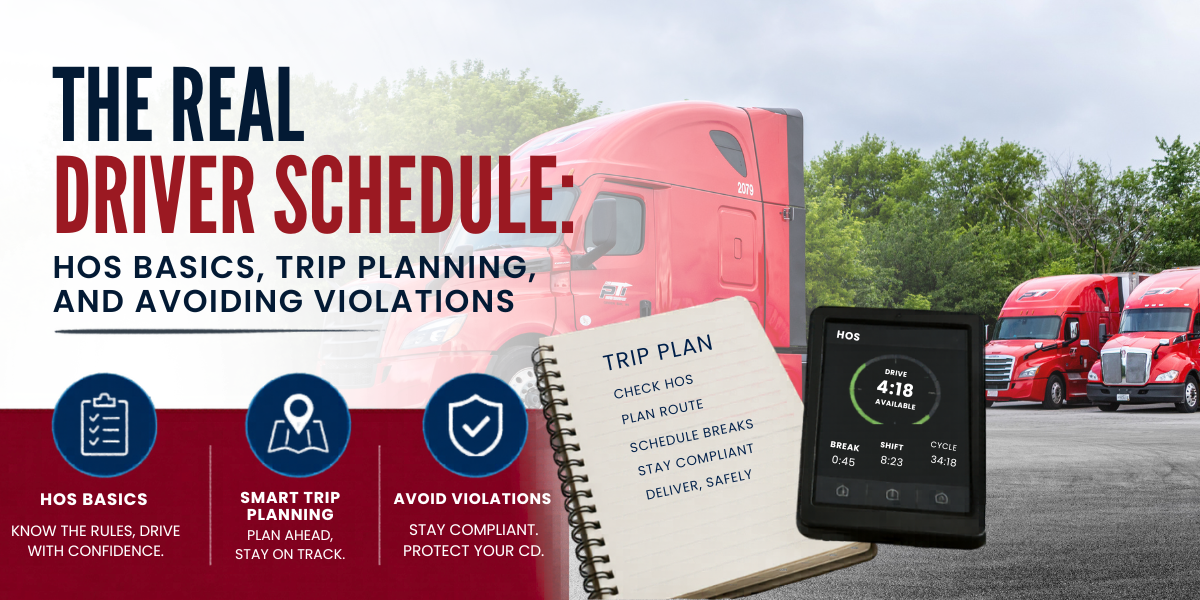
The Real Driver Schedule: HOS Basics, Trip Planning, and Avoiding Violations
Post Date - May 26, 2026
When people think about trucking, they picture the open road and not the clock. But ask any experienced driver, and they’ll tell you: your real schedule isn’t just miles and deliveries, it’s your Hours of Service (HOS).
Understanding HOS rules for truck drivers isn’t just about staying compliant. It’s about staying safe, maximizing your drive time, and avoiding costly violations that can slow you down or sideline your career. Let’s break it down in a way that actually reflects real life on the road.
Why HOS Matters More Than Ever
According to Centers for Disease Control and Prevention (CDC) research, 37% of long-haul drivers report being noncompliant with HOS rules at least some of the time. That same data ties poor sleep and irregular schedules to higher-risk driving events.
At the same time, the Federal Motor Carrier Safety Administration continues to evaluate Electronic Logging Devices (ELDs) and their role in improving compliance and safety. Bottom line: HOS isn’t just a regulation for drivers to follow, it’s a safety system that impacts every mile you drive.
HOS Rules Explained (Without the Confusion)
Here are the core DOT hours of service rules every driver needs to know:
The 11-Hour Driving Rule
You can drive up to 11 hours after 10 consecutive hours off duty.
The 14-Hour Rule (The Real Clock)
Once you start your day, you have a 14-hour window to complete all driving.
- This clock does not stop for breaks, fuel stops, or delays.
- Once it runs out, you’re done driving for the day.
Common question: Can truck drivers pause the 14-hour clock?
No—except when using specific sleeper berth split rules (more on that below).
The 30-Minute Break Rule
After 8 cumulative hours of driving, you must take a 30-minute break.
- Can be off-duty, sleeper berth, or even on-duty (not driving).
The 70-Hour Rule (Weekly Limit)
You can’t drive after 70 hours on duty in 8 days (or 60 in 7 days, depending on your carrier).
Common question: What is the 70-hour rule and how does recap work?
As older hours “fall off” your rolling 8-day window, you regain drive time—this is called recapping.
Sleeper Berth Split Rules (Your Flex Option)
The sleeper berth split rules give you flexibility, but only if you understand them.
8/2 Sleeper Split
- 8 hours in sleeper berth
- 2 hours off duty (or sleeper)
- Neither period counts against your 14-hour clock
7/3 Sleeper Split
- 7 hours sleeper + 3 hours off duty
- Also pauses the clock when used correctly
Common question: How does the sleeper berth split 8/2 work?
It essentially “freezes” your 14-hour window, letting you extend your driving day strategically.
Used right, this is one of the best tools for trip planning with HOS.
What Counts as On-Duty vs. Off-Duty?
Understanding this is key to avoiding HOS violations.
On-duty time includes:
- Driving
- Loading/unloading
- Fueling
- Inspections
- Waiting at a shipper (yes, even sitting still)
Off-duty time includes:
- Fully relieved from work
- Resting in sleeper berth
- Personal time
Misclassifying time is one of the most common ELD log mistakes.
Trip Planning with HOS: What Smart Drivers Do
The best drivers don’t just react to the clock. Instead, they plan around it.
Here’s how to stay ahead:
1. Start With Your 14-Hour Window
Work backward from your delivery time. Build in:
- Traffic
- Parking
- Delays at shippers
2. Know Where You’ll Stop
Don’t wait until you’re out of hours to find parking. That’s how violations happen.
3. Use Your Breaks Strategically
That 30-minute break? Use it for fuel, food, or timing your arrival.
4. Watch Your 70-Hour Clock
Running out of hours mid-load is avoidable with proper recap planning.
5. Use Sleeper Splits When Needed
They can save a load, but only if you understand the math.
Most Common HOS Violations (And How to Avoid Them)
Even experienced drivers slip up. Here’s what to watch for:
- Running over the 11-hour driving limit
- Driving past the 14-hour window
- Missing the 30-minute break
- Incorrect ELD logs
- Going over the 70-hour weekly limit
How to avoid HOS violations?
- Double-check logs daily
- Plan before you roll
- Don’t “wing it” at the end of your shift
- Use your ELD as a tool—not just a tracker
What Happens If You Get an HOS Violation?
Violations don’t just mean a warning—they can impact your record and your income.
Possible consequences:
- Fines
- CSA score impact
- Out-of-service orders
- Delays in delivery
- Increased scrutiny on future inspections
In short: violations cost time, money, and opportunity.
At Paper Transport, we know your schedule isn’t just about the miles, it’s about having the support, planning, and respect that make those miles count. From smart routing to a team that understands real driver schedules, we’re here to help you stay on track and make the most of every hour.
If you’re looking for a place where your time—and how you use it—actually matters, Paper Transport might be the right next move.